
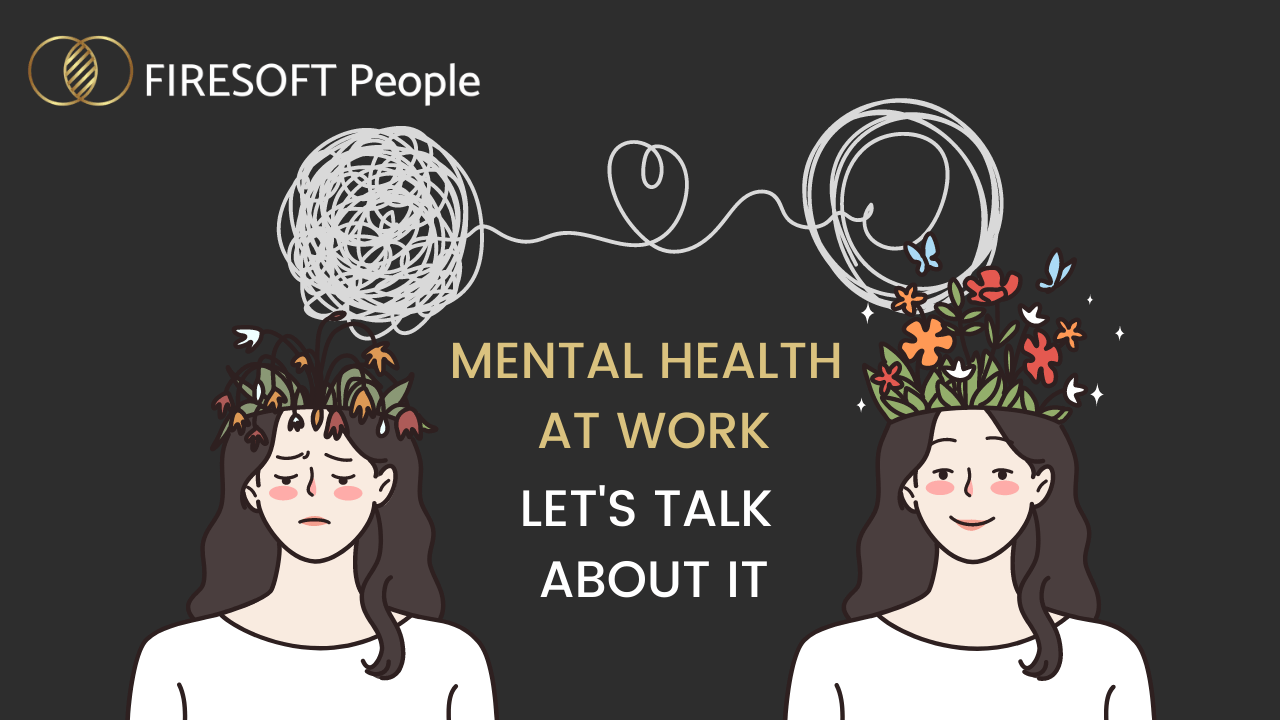
Mental Health at Work, Let's Talk About It
October 13, 2022

Mental health can sometimes be a subject that some are not naturally comfortable discussing, but in recent years, it has been more openly discussed than ever, specifically in the workplace. Many have experienced burnout and anxiety with the changes that had to be made so that companies can adapt, endure, and thrive with the challenges that come their way.


Organisations have adopted mental health programs as a part of their employee benefits package, which may include seminars and webinars focusing on mental health topics, an extra mental health day off or providing therapy consultation sessions to their employees. Some organisations have incorporated programs to train managers on the signs of anxiety and depression and how to assist people experiencing them. Your mental health is just as important as your physical health. When one of them isn’t healthy, your performance could be affected. Here are other ways to support mental wellness at work:


It’s Okay to Let Your Guard Down

Showing vulnerability may encourage others to openly express what they’re feeling or what’s been bothering them. Having a manager who is not only a rock holding the team together but also someone who can model encouraging behaviours to let the team be and feel human in the best of times and in the worst of times would be immensely beneficial. Being open with each other could also enrich relationships and build trust.


Expressing Gratitude

Giving a co-worker a genuine compliment or simply saying thanks to that co-worker who helped you finish that presentation can go a long way. Sometimes, one comment you receive could make or break your day. Expressing gratitude is not only for other people. Remember to also thank yourself for doing the best you can every day.


Don’t Ever Feel Guilty for Doing Something for Yourself

The hustle culture, coupled with the unpredictable state of the world right now, has at times led people to burnout, anxiety, and depression in the workplace. Take that much-needed time off, and don’t feel guilty about it. Your body isn’t the only thing that needs rest. Your mind will thank you for it, too. Making a habit of carving out time in your busy schedule to do something that’s just for you, something that would make you happy, could also make you feel great and give you a sense of satisfaction. It may be going to that spin class after work, practising yoga in the comfort of your own home, writing in your journal while taking that first cup of coffee, or listening to music to pump yourself up for the day. It could be anything that seems mundane to others but something important to you that puts a smile on your face.


Supportive Work Culture

We work better when surrounded by people who make us feel valued. A sound support system from your manager and peers will help foster a healthy environment. Giving and taking support from each other will make you feel like you are not alone, especially during tough times. When you’re sad and going through something, try to open up with your manager about it. You’re not a robot with a switch that can just function when turned on. You’re human, and you can only take on so much. Knowing that your manager and team have your back will help ease some of your worries.


It’s vital to take care of your mental health just as much as your physical health. The more people talk about mental health issues and illnesses, the more people will begin to be more open and understanding of it. We are feeling human beings, and that should be celebrated. It will only take one person to start the conversation, so let’s talk.

Other suggested reads for you

By Shazamme System User April 21, 2026
Why Connection Matters More Than Ever Networking is a Leadership Skill In today’s fast-moving and highly connected world, leadership is no longer defined solely by expertise or experience. It is increasingly defined by the strength of the relationships you build and the ecosystems you create around you. As highlighted in your material, great leaders don’t just build strong teams — they build strong ecosystems that allow ideas, opportunities, and people to thrive together. Networking has evolved significantly. It is no longer a transactional activity driven by short-term gain or opportunistic interactions. Instead, it has become relational, strategic, and deeply embedded in how effective leaders operate. The ability to connect, collaborate, and support others is now one of the most underrated — yet most powerful — leadership skills in 2026. Leadership Is No Longer About What You Know Traditionally, leadership was measured by knowledge, expertise, and the ability to make decisions based on experience. While these qualities remain important, they are no longer sufficient on their own. The modern leader operates in an environment where change is constant, information is abundant, and no single person can know everything. Today, leadership is defined by who you can learn from, who you can collaborate with, and who you can support. Strong networks allow leaders to access new perspectives, stay informed about emerging trends, and continuously evolve their thinking. This shift from individual knowledge to collective intelligence is what separates good leaders from truly effective ones. Reframing Networking: From Contacts to Communities One of the biggest misconceptions about networking is that it is about collecting contacts. In reality, that approach is outdated and ineffective. Networking today is not about handing out business cards, pitching yourself to everyone you meet, or adding connections on LinkedIn without ever engaging again. Instead, networking has shifted toward building meaningful communities. The most effective leaders intentionally connect across industries, roles, and seniority levels — not just within their immediate circles or comfort zones. By doing this, they gain exposure to diverse ideas, uncover opportunities earlier, and build adaptability into their leadership approach. At its core, modern networking is about building trust over time. It is about exchanging ideas, not just opportunities, and creating relationships rooted in mutual growth. Leaders who embrace this mindset move beyond surface-level connections and develop networks that genuinely add value to their work and decision-making. Why Networking Makes You a Better Leader Strong networks act as a multiplier for leadership effectiveness. Leaders who invest in building and maintaining meaningful connections are able to “see around corners” — they hear about changes, challenges, and opportunities before they become widely visible. This gives them a strategic advantage in decision-making. In addition, diverse networks provide access to a wide range of perspectives. Instead of relying solely on internal viewpoints, leaders can draw insights from different industries, roles, and experiences, leading to more informed and balanced decisions. This diversity of thought is critical in navigating complexity and uncertainty. Networking also builds resilience. Leaders who are connected are less dependent on a single team, market, or idea. They have access to broader support systems, enabling them to adapt more quickly when circumstances change. Beyond this, strong leaders use their networks not just for personal gain, but to create opportunities for others — opening doors, making introductions, and helping people grow. True influence, as your content highlights, does not come from title or position. It comes from the value you create for others. The most powerful form of networking is rooted in generosity — sharing insights, mentoring others, and helping without expecting immediate returns. Over time, this builds trust, and trust compounds into long-term influence. Turning Networking Into Leadership in Action While networking is often discussed at a strategic level, it is ultimately built through simple, consistent actions. One of the most effective practices leaders can adopt is to intentionally create time for meaningful conversations outside their immediate circle. A practical approach is to dedicate just one hour each month to reconnect with someone new or someone you haven’t spoken to in a while. The goal is not to sell or pitch, but to listen. Asking questions such as “What’s changing in your world right now?”, “What are you learning?”, or “What challenges are you seeing?” can open up valuable insights and perspectives. These conversations often lead to unexpected outcomes. A single honest discussion can shift your thinking, spark a new idea, or open a door you didn’t even know existed. Over time, these small actions compound into a strong and valuable network. This is where the true distinction lies. Networking is not just an activity — it is a leadership practice. When done with intention, authenticity, and consistency, it becomes a powerful driver of growth, influence, and long-term success. Final Thought In 2026, the most effective leaders are not the ones with the most connections, but the ones with the most meaningful relationships. They understand that leadership is not built in isolation, but through collaboration, trust, and shared growth. Because in the end, networking is not about expanding your contact list. It is about expanding your perspective, your impact, and your ability to lead. And that is what makes connection matter more than ever.
By Shazamme System User April 21, 2026
Technology Leadership in 2026 What Future-Ready Leaders Do Differently Technology continues to accelerate at an unprecedented pace. AI, automation, data platforms, and digital ecosystems are evolving almost daily, reshaping how organisations operate and compete. But in 2026, the biggest differentiator is no longer the technology itself. It is how leaders enable their people to grow alongside it. The most effective organisations are not simply those with the most advanced tech stacks. They are the ones with leaders who understand that technology without people capability is limited. Future-ready leadership is no longer about just driving systems forward — it is about building teams that can continuously adapt, learn, and evolve in parallel with change. Leadership Has Shifted In the past, technology leadership was often defined by execution. Delivering projects faster, scaling systems efficiently, and managing output were considered the core responsibilities of leaders. While these still matter, they are no longer enough in today’s environment. Leadership in 2026 has shifted toward a more human-centric approach. Future-ready leaders understand that technology is only as strong as the teams behind it. They don’t just manage outputs — they design environments where learning, trust, and adaptability can thrive. This means creating a culture where teams feel empowered to grow, experiment, and contribute beyond their immediate responsibilities. Modern leadership now sits at the intersection of technical clarity and human insight. It requires not only understanding systems and architecture, but also understanding people — their motivations, their growth paths, and how they perform at their best. People Roadmaps Matter as Much as Tech Roadmaps One of the most important shifts we are seeing is the rise of the “people roadmap.” Traditionally, leaders focused heavily on technical roadmaps — planning architecture, selecting tools, and defining delivery timelines. While this remains critical, it is no longer sufficient on its own. Today’s most effective leaders run two roadmaps in parallel: a technical roadmap and a people roadmap. The technical roadmap focuses on systems, platforms, and capabilities, while the people roadmap focuses on skills, career development, and capability depth within the team. This shift requires leaders to think ahead, not just about technology, but about talent. Questions such as “What skills will this team need in 12 to 24 months?” or “Who needs mentoring or stretch opportunities today?” are becoming central to leadership strategy. Growth is no longer something that happens naturally over time — it is intentional and designed. Organisations that invest in people development alongside technical growth are better positioned to adapt, scale, and retain talent in a rapidly changing environment. Hiring for Adaptability, Not Just Skill In 2026, talent is no longer static. Roles are evolving faster than ever, and the skills required today may not be the same in a year’s time. This has fundamentally changed how organisations approach hiring. Future-ready leaders are shifting their focus away from purely technical capability and toward adaptability. They are hiring for curiosity, learning speed, and mindset — qualities that enable individuals to grow with the role rather than outgrow it. Cultural contribution is also becoming just as important as technical expertise, as teams increasingly rely on collaboration and diverse perspectives. The key question in hiring has changed. It is no longer just “Can this person do the job today?” but rather “Can this person evolve with the role tomorrow?” This shift allows organisations to build teams that are resilient, flexible, and capable of continuous re-skilling, rather than teams that become outdated as technology changes. Inclusion, Trust, and Psychological Safety High-performing technology teams are not just defined by intelligence or technical capability — they are defined by how safe people feel within them. In 2026, psychological safety has become a critical foundation for performance. Strong leaders actively encourage questioning, challenge, and open dialogue. They normalise experimentation and accept that failure is part of the learning process. They also create space for diverse voices and perspectives, recognising that innovation thrives when people feel comfortable sharing ideas without fear of judgment. Innovation happens faster in environments where individuals are not afraid to speak up. Trust is no longer a “nice to have” — it is infrastructure. Without it, teams become risk-averse, communication breaks down, and progress slows. With it, organisations unlock creativity, speed, and stronger collaboration across teams. Practical Action for Leaders While many of these concepts may seem strategic, they are built through simple, consistent actions. One of the most effective practices emerging in 2026 is the concept of “learning loops.” Learning loops are regular, structured opportunities for teams to share knowledge and learn from each other. These can take the form of monthly or fortnightly sessions where individuals across different functions — engineers, analysts, product teams, and creatives — exchange insights and experiences. The goal is not formal training, but continuous, informal learning that builds collective capability. This approach reinforces a culture of curiosity and shared growth. It breaks down silos, encourages collaboration, and helps teams stay ahead of change. More importantly, it strengthens engagement and retention, as individuals feel they are continuously developing and contributing. Curiosity fuels innovation, and innovation fuels retention. Leaders who embed learning into their teams create environments where both individuals and organisations can thrive. Final Thought Technology leadership in 2026 is no longer defined by systems alone. It is defined by how effectively leaders balance technical direction with human development. The most successful leaders are not just those who deliver faster or scale bigger systems. They are the ones who build teams that can evolve, adapt, and grow continuously in a world of constant change. Because in the end, technology will keep advancing. But it is people — enabled by the right leadership — who determine how far organisations can truly go.
By Shazamme System User April 15, 2026
Why Website Speed Matters for Recruitment Firms How Speed, AI, and User Experience Are Redefining Talent Acquisition In today’s recruitment landscape, your website is no longer just a digital presence. It’s your primary hiring engine. And in 2026, that engine is powered by AI, real-time data, and candidate expectations that demand instant results. Yet one factor continues to be underestimated — website speed. Behind every delayed page load is a missed opportunity: A candidate who drops off before applying A high-value applicant who never completes the process A hiring team that receives fewer qualified profiles Website performance is no longer a technical concern. It is a direct driver of applications, engagement, and revenue. Recruitment Websites Have Evolved — But Expectations Have Evolved Faster Modern recruitment platforms are no longer static job boards. They are AI-enabled ecosystems designed to manage and optimise the entire hiring journey. As highlighted in your material (page 2), today’s platforms include: AI-powered job recommendations Smart search and matching Instant application flows Automated communication These capabilities fundamentally change how candidates interact with your website. Candidates no longer browse — they expect: Immediate relevance Personalised job discovery Seamless, frictionless application journeys This is where speed becomes critical. Because AI doesn’t just enhance the experience — it depends on speed to function effectively. Without fast load times and real-time responsiveness, even the most advanced AI tools fail to deliver value. The Real Cost of a Slow Website Speed isn’t just about user experience — it has measurable business impact. According to the data in your slides (page 3): A 1-second delay can reduce conversions by up to 7% 40% of users abandon websites that take longer than 3 seconds to load Now apply that to recruitment. Every second of delay impacts: Job search results loading Application form completion Candidate engagement And when your platform slows down: AI job matching becomes less effective Application flows break or lag Candidates abandon the process The outcome? Fewer qualified candidates entering your pipeline. In a competitive talent market, this is not a small issue — it’s a compounding disadvantage. AI + Speed = Competitive Advantage One of the biggest shifts in recruitment is the rise of predictive AI-driven platforms. As shown on page 4 of your document, AI can now detect: When a candidate is likely to apply When they are exploring a specific sector When they are comparing multiple roles This allows recruitment platforms to surface the right opportunities at the right time. But here’s the key insight: Prediction without speed creates friction. Prediction with speed creates conversion. If your website can’t instantly respond to candidate intent, you lose the advantage AI provides. The Rise of Predictive Page Loading Modern browser technologies — such as Speculation Rules API and AI-driven UX — are transforming how recruitment websites perform. As outlined in your content (page 5), these technologies enable platforms to: Predict user behaviour Preload relevant job pages Recommend similar roles Reduce friction in applications The result? A near-instant candidate experience.This is no longer a “nice to have” — it’s quickly becoming the standard. Candidates don’t compare your website to other recruitment firms. They compare it to: Google LinkedIn Amazon-level experiences If your platform feels slow, outdated, or clunky — they simply leave. The Business Impact: Faster Websites = Faster Hiring Speed doesn’t just improve user experience — it directly improves hiring outcomes. According to your data (page 6): AI recruitment tools can reduce time-to-hire by up to 40% Recruiters using AI report 30% faster candidate screening When combined with high-performing websites, this leads to: Faster hiring cycles More qualified applicants Higher recruiter productivity In other words: Speed is not just a technical upgrade. It is an operational advantage. Mobile + AI: Where Speed Matters Most The shift to mobile-first job searching has accelerated dramatically. From your insights (page 7): Over 70% of job searches now start on mobile Over 60% of candidates expect personalised job recommendations This creates a new baseline for recruitment platforms. Your website must be: Fast Mobile-optimised AI-integrated Mobile users are even less tolerant of delays. A slow mobile experience doesn’t just frustrate users — it kills conversions instantly. The Future of Recruitment Websites The next generation of recruitment platforms is already emerging. As highlighted in your final page (page 8), they will be: Faster AI-driven Predictive Personalised These platforms will: Show candidates the right opportunities instantly Engage talent before competitors do Continuously optimise based on user behaviour And at the centre of it all is one key idea: Your website is no longer just a website. It is your AI-powered recruitment engine. Final Thought: Speed Is No Longer Optional The recruitment firms that win in 2026 and beyond won’t just have better recruiters or bigger networks. They will have better platforms. Platforms that: Respond instantly Predict candidate behaviour Remove friction at every step Convert interest into applications seamlessly Because in a world where candidates expect everything instantly: Speed is no longer a technical metric. It is a competitive advantage.